 how-to
Troubleshoot RV Propane System Issues
Table of Contents
- How to Troubleshoot RV Propane System Issues
- Check the Tank Valve and Supply
- RV Propane Regulator Troubleshooting
- Diagnose RV Stove Not Lighting Issues
- Fix RV Water Heater Not Working on Propane
- Respond to RV Propane Detector Beeping
- Test for Propane Leaks
- When to Call a Qualified Technician
- Frequently Asked Questions
Last Updated: October 11, 2026
How to Troubleshoot RV Propane System Issues
When your RV propane system stops working, the problem often has a simple fix. At ONSITE RV RENTAL AND REPAIR, we help RV owners diagnose and resolve propane issues quickly. Most common problems stem from closed valves, regulator failures, or air in the lines, not expensive system damage.
This guide walks you through how to troubleshoot RV propane system issues step by step. We'll cover tank checks, regulator resets, appliance diagnostics, and when to call a qualified technician. By following these steps, you'll identify the root cause and know whether you can fix it yourself or need professional help.
Check the Tank Valve and Supply
The first step in troubleshooting RV propane problems is verifying your tank valve is open and your tank contains propane. Many owners discover their propane isn't flowing simply because the tank valve was accidentally closed, never fully opened, or the tank is empty.
Verify the tank valve is open
Locate your propane tank. The service valve (also called the tank valve) has a handle on top. Turn the handle counterclockwise until it stops. The handle should be parallel to the tank opening, not perpendicular. A perpendicular handle means the valve is closed.
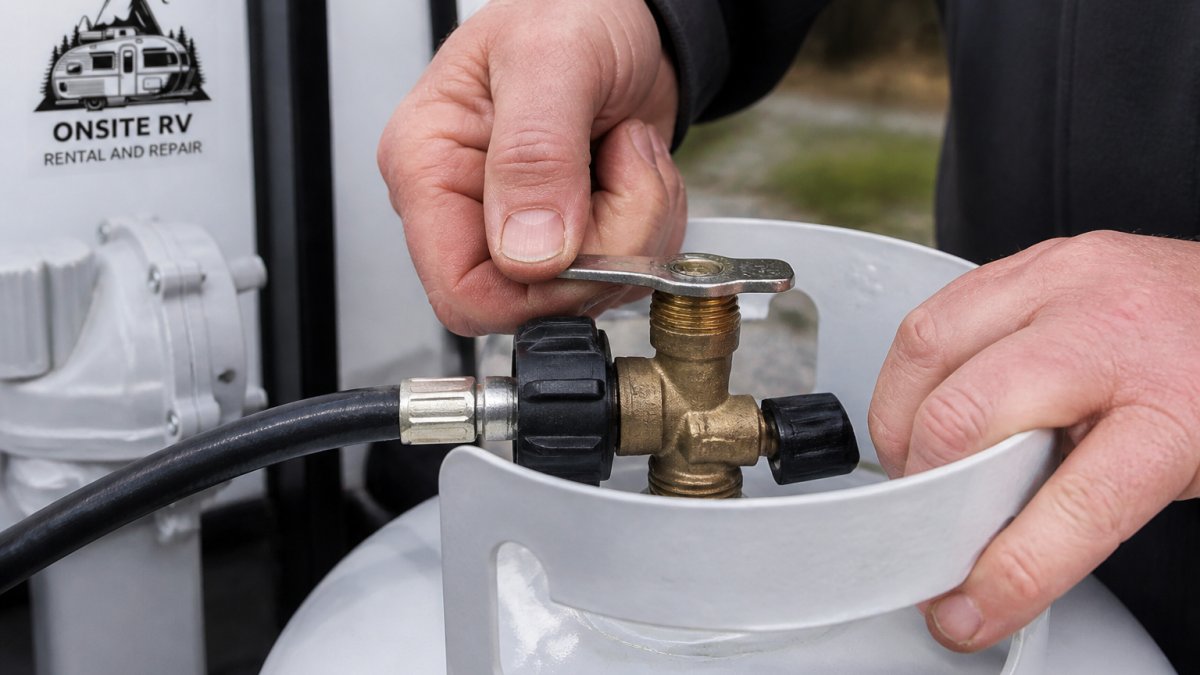
Turn slowly. Don't crank it hard. If you open it too fast, you risk triggering the excess-flow safety device, which will shut down your system. Take 3-5 seconds to reach full open.
Check whether the tank is empty
If the valve is open but no appliances light, the tank may be empty. Check the tank gauge or weight indicator on the side of your propane tank. Most RV tanks have a dial gauge showing fuel level as a percentage. If the gauge reads near zero or shows red, your tank is empty and needs refilling.
If your RV has a dual-tank setup with a changeover valve, verify which tank is selected. The changeover valve has a lever or dial that points to Tank 1 or Tank 2. If the lever points to an empty tank, switch it to the full tank. Wait 30 seconds for pressure to stabilize, then test your appliances. Many owners believe their system has failed when they've simply selected an empty tank.
If you cannot read the gauge clearly or suspect it is faulty, use the weight method: propane weighs approximately 0.58 kg per litre. A full 11 kg tank (common in RVs) should weigh about 30 kg total (11 kg propane plus 19 kg empty tank weight). Weigh your tank on a bathroom or truck scale. If it weighs close to the empty weight stamped on the tank collar, refill it.
Understand the excess-flow safety device
Modern RV propane tanks have a built-in safety feature called an excess-flow device. This device activates if propane rushes out too quickly, which signals a major leak. When triggered, it blocks all gas flow until you reset it.
The device activates when you open the tank valve too fast. If this happens, your appliances won't light even though the tank is full and the valve is open. The fix is simple: close the tank valve completely, wait 30 seconds, then open it again slowly over 3-5 seconds. This resets the excess-flow device and restores normal flow.
If the valve is stuck and won't turn, do not force it. A stuck valve indicates corrosion or mechanical damage and requires professional service. Call a qualified technician rather than risk damaging the valve stem.
RV Propane Regulator Troubleshooting
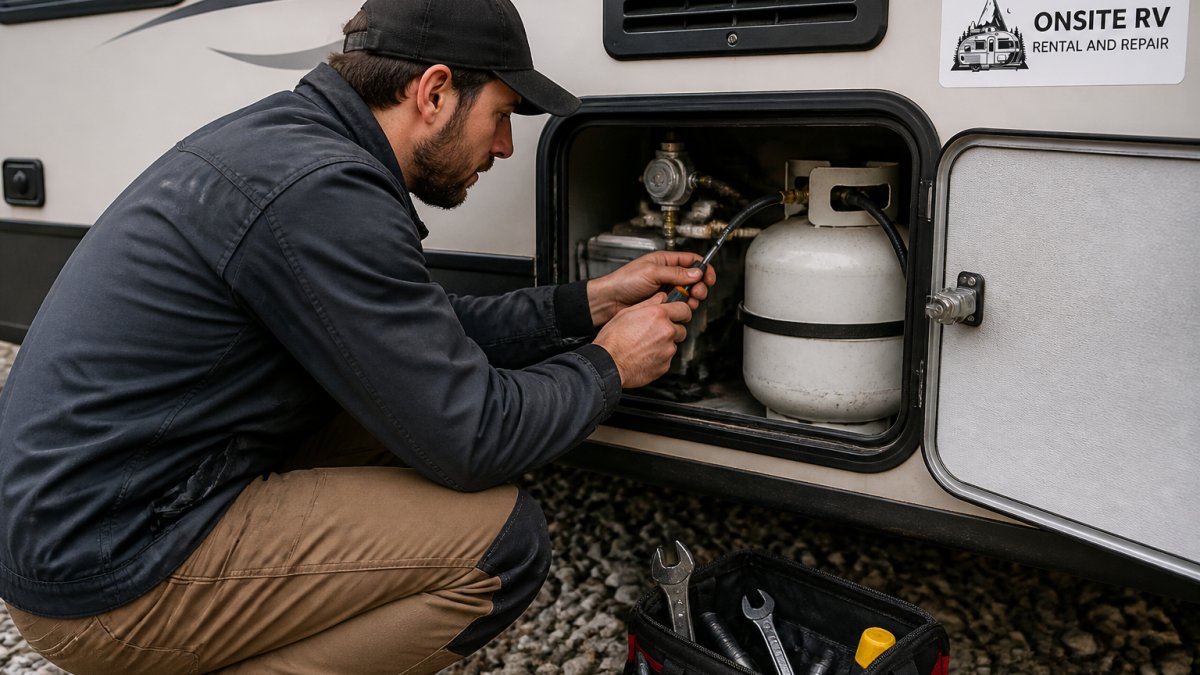
The regulator controls propane pressure as it flows from the tank to your appliances. A failing regulator is one of the most common reasons for weak or inconsistent propane flow. Understanding regulator symptoms and how to isolate a regulator fault from tank or supply-line problems is key to accurate diagnosis.
Recognize regulator failure symptoms
A failing regulator shows specific warning signs. Your stove burners may light but produce weak, yellow flames instead of strong blue flames. Your water heater might work intermittently or not at all. Some appliances light while others don't, typically the furnace lights but the stove doesn't, or vice versa. You might smell propane near the regulator housing or see frost or ice accumulation on the regulator body (frost indicates internal pressure drop and gas expansion, a sign of regulator failure). In cold weather, a failed regulator may cause all appliances to lose pressure simultaneously.
Regulators fail due to age, temperature cycling, internal corrosion, or moisture in the propane line. Once a regulator fails, it cannot be repaired; it must be replaced by a qualified technician.
Isolate a regulator fault from tank or supply problems
Before assuming your regulator is broken, confirm the problem is not upstream. If your tank valve is closed or the tank is empty, the regulator will not receive pressure and appliances will not light, but this is not a regulator fault.
Test the supply reaching the regulator by opening the tank valve slowly and listening for a hissing sound near the regulator inlet. If you hear hissing, propane is flowing into the regulator. If you hear nothing, the tank is empty, the valve is closed, or the supply line is blocked.
Next, test appliances in sequence. Light your stove first. If it lights with a strong blue flame, the regulator is delivering normal pressure. If the stove produces a weak yellow flame or won't light, move to the next appliance. Light your furnace or water heater. If the furnace lights strongly but the stove doesn't, the problem is likely a stove-specific issue (blocked line, faulty valve, or igniter), not the regulator. If neither appliance lights and you've confirmed the tank is open and full, the regulator is likely faulty.
Reset the regulator safely
Before assuming your regulator is broken, try a manual reset. This often restores normal function if the regulator has simply shut down due to a pressure imbalance or thermal event.
Close the tank valve completely. Wait 5 minutes. Open the tank valve slowly over 3-5 seconds. Go to your stove and attempt to light a burner. If the burner lights with a strong blue flame, the reset worked. If not, your regulator likely needs replacement.
Understand what a qualified technician measures
A qualified technician uses a propane pressure gauge to test regulator output. Normal regulator output in an RV is typically 10-12 inches of water column (about 0.36-0.43 kPa). If the gauge reads significantly lower, the regulator is failing. If the gauge reads zero, the regulator has failed completely.
Do not attempt to adjust a regulator yourself by tightening or loosening adjustment screws. Regulators contain precision components and pressurized gas. Improper adjustment can cause gas leaks, inconsistent pressure, or system damage. Only a qualified technician should service them.
Diagnose RV Stove Not Lighting Issues
When your RV stove won't light, the problem is usually one of three causes: no propane reaching the stove, a faulty igniter, or air trapped in the propane line.
Start by checking your tank valve is open and the regulator is functioning. Light another appliance, your water heater or furnace. If those work, propane is reaching your system. The problem is specific to the stove.
If no appliances light, the issue is upstream: tank valve, regulator, or main line. Refer to the sections above.
If the stove is the only problem, try purging the line. Turn the stove burner dial to the ignition position and hold it for 15 seconds. You may hear hissing as air escapes. After 15 seconds, release and try lighting again. Repeat this 2-3 times. Air in the line often clears after a few purge attempts.
If the stove still won't light after purging, the igniter may be faulty. This requires replacement by a technician.
Fix RV Water Heater Not Working on Propane
RV water heaters that run on propane fail for similar reasons as stoves: no gas supply, regulator issues, or pilot light problems.
First, confirm other propane appliances work. If your stove and furnace function normally, propane is reaching your system. The water heater-specific issue is usually a failed pilot light or a faulty thermostat.
Check the water heater's pilot light. Many RV water heaters have a small window where you can see the pilot flame. If the pilot is out, follow the manufacturer's instructions to relight it. This typically involves holding the pilot button while using the igniter. If the pilot won't stay lit, the thermocouple (a safety sensor) may have failed.
Thermocouples fail over time and must be replaced. This is a job for a qualified technician, but it's a straightforward repair that keeps your water heater functional.
If the pilot light is burning but the heater won't produce hot water, your thermostat control may be faulty. Verify the temperature dial is set above the minimum setting. If it is, the control mechanism needs professional service.
Respond to RV Propane Detector Beeping
Your RV propane detector beeps when it senses propane in the air. This is a safety alert, not a system malfunction. Propane itself is odorless, so manufacturers add a rotten-egg smell and install detectors to warn you of leaks.
If your detector beeps, evacuate the RV immediately. Do not use electrical switches, lighter, or any ignition source. Propane is highly flammable.
Once outside, call a qualified technician. Do not re-enter the RV until a professional confirms the leak is found and repaired. Propane leaks are serious and require expert diagnosis.
Test for Propane Leaks
Regular leak testing keeps your system safe. You can perform a basic leak check yourself using soapy water.
Mix dish soap with water in a spray bottle. Spray the mixture on all visible propane connections: where the line connects to the tank, where it enters the RV, and where it connects to appliances. Watch for bubbles. Bubbles indicate escaping propane.
If you find bubbles, close the tank valve and call a technician. Do not attempt to tighten or repair connections yourself. Propane fittings require specialized tools and expertise.
A qualified technician can perform pressure testing with specialized equipment. This detects leaks you cannot see and ensures your entire system is airtight. We recommend annual pressure testing as part of routine maintenance.
When to Call a Qualified Technician
Know the limits of DIY troubleshooting. Call a qualified technician if:
- Your tank valve is stuck or won't open
- The regulator shows signs of failure (frost, hissing, weak pressure)
- Appliances won't light after you've checked the tank valve and regulator
- You smell propane anywhere in your RV
- Your propane detector beeps
- The water heater pilot light won't stay lit
- You find leaks during your soapy water test
- Your system has been inactive for months and needs purging
ONSITE RV RENTAL AND REPAIR provides comprehensive propane diagnostics and repair. Our technicians can visit your RV location or service your rig. We handle regulator replacement, line repairs, appliance service, and full system pressure testing. Whether you need emergency repairs or routine maintenance, we're equipped to keep your propane system safe and reliable.
Propane system failures can disrupt your travel plans and create safety risks. Most common issues, closed valves, regulator problems, and air in lines, have straightforward fixes. But propane is dangerous when handled incorrectly. If you've worked through the diagnostic steps above and still have issues, or if you've found a leak or smell propane, contact ONSITE RV RENTAL AND REPAIR for professional service. Our team knows RV systems inside and out. We'll diagnose the problem accurately and get you back on the road safely. Call to book an appointment today.
Frequently Asked Questions
Why is my RV propane system not working?
The most common causes are a closed tank valve, a tripped excess-flow safety device, or a faulty regulator. Start by checking that the tank valve is fully open by turning it counterclockwise. If propane still won't flow, the excess-flow device may have activated due to a sudden pressure drop. Close the tank valve, wait 30 seconds, then reopen it slowly. If appliances still won't light, the regulator may need resetting or replacement by a qualified technician.
How do I reset an RV propane regulator?
To reset the regulator, close the tank service valve completely, then turn off all appliances and burners. Wait 5 minutes for pressure to equalize. Reopen the tank valve slowly (one-quarter turn at a time) to avoid triggering the excess-flow safety device again. Light a stove burner to purge air from the line. If the regulator still fails to deliver pressure, it requires replacement by a qualified technician.
What should I do if I smell propane in my RV?
Do not use any electrical switches, lighters, or ignition sources. Immediately close the tank service valve and open all windows and doors for ventilation. Move to fresh air outside the RV. Check hose connections and fittings with soapy water to identify leaks (bubbles indicate escaping gas). If you find a leak, do not attempt to repair it yourself. Contact ONSITE RV RENTAL AND REPAIR or a qualified technician for safe inspection and repair.
How can I tell if my RV propane regulator is faulty?
Signs of regulator failure include inconsistent flame on burners, appliances lighting then shutting off unexpectedly, low gas flow even with the tank full, or no propane delivery at all despite an open tank valve. A faulty regulator cannot be reliably repaired and should be replaced. If resetting the regulator does not restore normal operation, have a qualified technician inspect and replace it.