 How-to
Can a Mobile Mechanic Fix an RV Transmission?
Last Updated: November 1, 2026
Quick Summary
Mobile mechanics can often handle RV transmission problems that involve fluid checks, sensors, wiring, linkages and diagnostic codes. Major internal work such as a rebuild or swap usually needs a shop with a lift and specialized tools.
- Fluid checks, code reading, linkage adjustments and cooler line checks are usually done on-site.
- Slipping, burning smell or dark fluid means stop driving the RV as soon as it is safe.
- Ask whether the diagnostic fee is credited toward the repair if you approve the work.
- Confirm campground rules before booking, since some parks prohibit vehicle repairs on site.
- Request an itemized quote covering diagnostic fee, travel charge, labour hours and parts.
Table of Contents
- What a Mobile Mechanic Can and Cannot Do on an RV Transmission
- RV Transmission Warning Signs That Need Attention Now
- RV Transmission Diagnosis: What Happens During an On-Site Check
- On-Site Repair Versus a Shop: A Decision Guide
- When to Tow an RV for Transmission Repair
- RV Transmission Repair Cost: What Drives the Quote
- Mobile Mechanic Pros and Cons for Transmission Work
- Preparing for a Mobile Transmission Visit and Booking Your Appointment
- Frequently Asked Questions
What a Mobile Mechanic Can and Cannot Do on an RV Transmission
Can mobile mechanics fix RV transmission problems? Often, yes, but it depends on the fault. Larger jobs, such as a full rebuild or a transmission swap, usually need a shop with a lift and specialized tools.
Here is a quick way to sort the work:
- Usually on-site: fluid checks and top-ups, fluid condition checks, diagnostic code reading, linkage and shifter adjustments, cooler line checks.
- Often needs a shop: internal solenoid or valve body work, clutch pack replacement, torque converter issues, full transmission removal.
A common mistake is assuming the transmission is the problem when the cause is the fluid, a sensor, or a wiring fault. A mobile visit can help answer that question.
RV Transmission Warning Signs That Need Attention Now
RV transmission problems rarely appear without warning. Catching them early can prevent a much larger bill.
Watch for these signs:
- Slipping, where the engine revs but the RV does not pick up speed
- Delayed or harsh shifts between gears
- Burning smell or dark, dirty transmission fluid
- Whining, clunking, or grinding noises when in gear
- Fluid leaks under the RV
- Warning lights on the dash, especially the check engine or transmission temperature light
If you notice slipping or a burning smell, stop driving the RV as soon as it is safe. Continuing to drive can turn a fluid problem into internal damage.
RV Transmission Diagnosis: What Happens During an On-Site Check
A mobile diagnostic visit typically involves discussing symptoms, reviewing fault codes and checking fluid, leaks and connectors, followed by an explanation of the findings. You can read a step-by-step guide to booking a mobile RV inspection and what to expect before the visit.
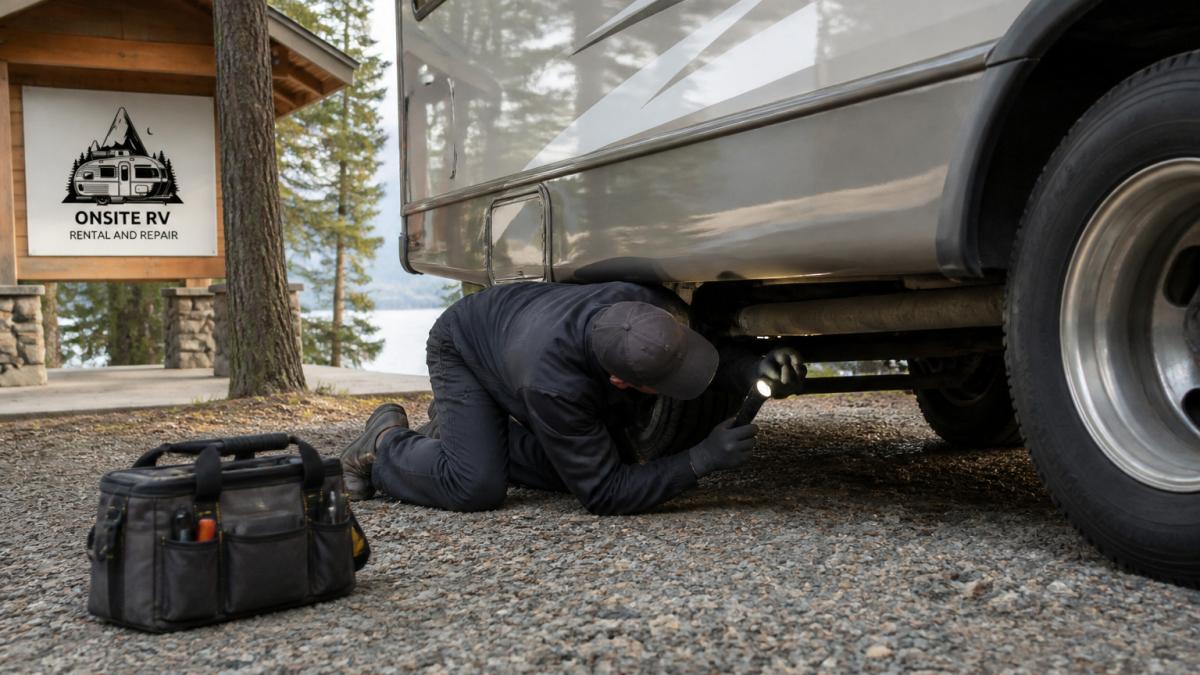
Ask the technician to explain what they found and what they still need to check.
On-Site Repair Versus a Shop: A Decision Guide
Transmission repairs vary in complexity. Knowing which tier your fault falls into can help you decide between a mobile visit, a tow, or a shop.
Tier 1: Work That Usually Stays On-Site
These jobs need hand tools, a scan tool, and safe access underneath the RV, nothing a well-equipped mobile truck does not carry.
- Fluid level and condition checks, where the dipstick or fill port is reachable
- Fluid and filter service on units with a serviceable pan and adequate ground clearance
- Shifter, linkage, and cable adjustments
- External sensor replacement (input/output speed sensors, temperature sensors)
- Wiring and connector repairs to the transmission harness
- Cooler line, pan gasket, and external seal leaks
- Diagnostic code reading and live-data review during a test drive
A common pattern is that a fault blamed on the transmission turns out to be a fluid level issue, a chafed harness, or a failing sensor, all Tier 1 work that a mobile visit can resolve in a single trip.
Tier 2: Borderline, Depends on the Chassis and the Site
These jobs can sometimes be done on-site, but only if the RV has the clearance, the workspace is safe, and the technician carries the right tooling. Ask specifically before booking.
- Solenoid pack replacement on units where the pan can be dropped without lowering the transmission
- Valve body service on transmissions with an accessible side cover
- Internal wiring harness replacement
- Transmission mount replacement
Three RV-specific constraints decide whether a Tier 2 job stays on-site:
- Ground clearance and jacking points. A Class C on a cutaway chassis sits higher than a Class A diesel pusher with a low-slung body, but both need stable, level ground and room to place jack stands or ramps. Gravel, soft turf, and unlevel campsites rule out under-vehicle work.
- Slide-outs, leveling jacks, and utilities. A deployed slide-out or lowered leveling jack can block access to the transmission tunnel or pan. The technician may ask you to retract them before arrival.
- Campsite and park rules. Many campgrounds prohibit vehicle repairs, fluid draining, or overnight immobilization on site. Confirm with the office before booking, a rule against repairs can force a Tier 2 job to a shop even when the technician is willing.
Tier 3: Work That Needs a Shop or Specialized Equipment
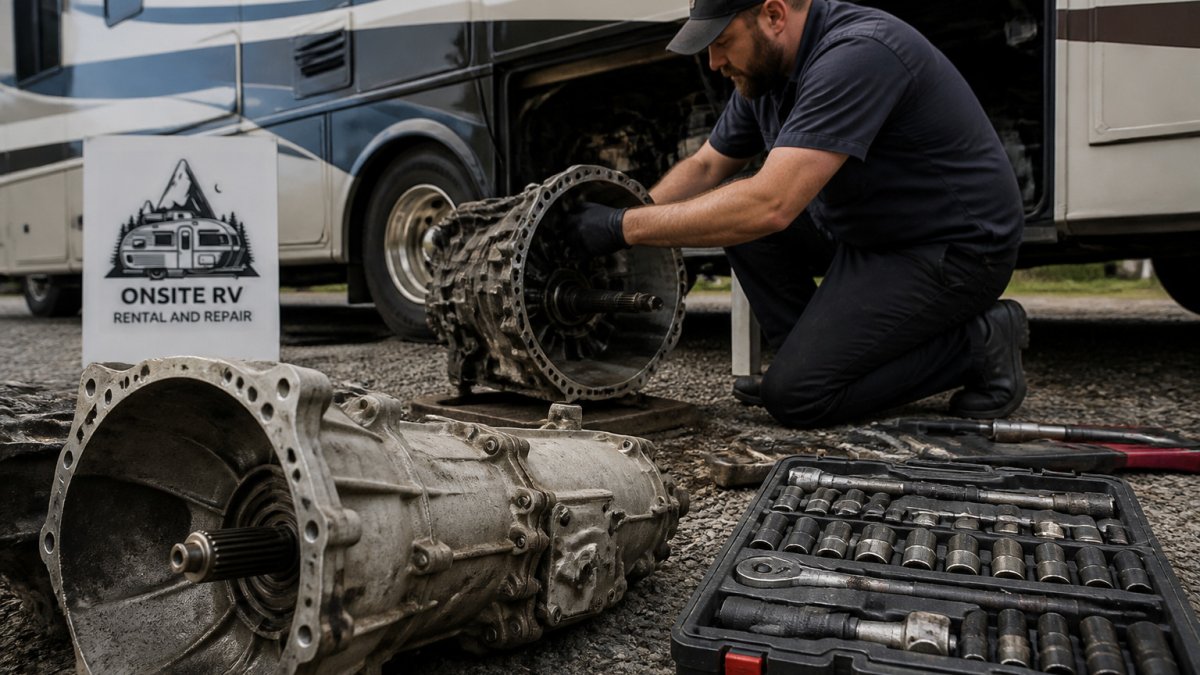
These jobs require a lift, transmission jack, fluid exchange equipment, and a clean bay. No mobile mechanic should promise them in a driveway or campground.
- Full transmission removal and reinstallation
- Internal rebuilds, clutch packs, bands, bearings, seals
- Torque converter replacement
- Transmission replacement or swap
- Full fluid flush using a exchange machine, where the manufacturer specifies it
- Post-repair relearn or adaptation procedures that require a sustained test drive
If the diagnosis points to Tier 3, the mobile visit still has value: you get a confirmed cause and a written estimate before you pay for a tow, so the shop is not diagnosing from scratch.
When to Tow an RV for Transmission Repair
Some situations call for a tow rather than a drive. Tow the RV if: (if you need immediate help, see our emergency RV repair guide for Vancouver Island for triage steps and contact options)
- The RV will not move, or moves only in one gear
- The transmission overheats or shows a temperature warning
- You smell burning fluid that does not go away
- You see fluid pouring from the vehicle
Ask your tow company whether the RV needs to be towed with the drive wheels lifted.
RV Transmission Repair Cost: What Drives the Quote
Transmission work is quoted rather than priced from a fixed menu, because the same symptom can come from very different repairs. Pricing depends on the diagnosed cause, parts and labour, so request an itemized quote.
What a Mobile Transmission Quote Should Itemize
Ask for each of these as a separate line, in writing:
- Diagnostic or service-call fee. A flat charge for the visit and scan, separate from repair labor. Confirm whether it is credited toward the repair if you proceed.
- Travel charge. Either a flat zone fee or a per-kilometre rate beyond a base radius. Ask for the base radius and the rate in writing before booking.
- Labor hours and rate. Hours estimated for the specific job, and the hourly rate. Tier 1 jobs are typically quoted in fractions of an hour; Tier 2 jobs in whole hours.
- Parts. Whether each part is new, rebuilt, or used, and whether it is OEM or aftermarket. Rebuilt and used units carry different warranty terms.
- Fluid and consumables. Transmission fluid is billed by the litre and varies widely by specification, a fluid that meets a specific manufacturer standard can cost several times a generic fluid.
- Shop or lift charges. If the job moves to a shop, the quote should show the lift time or sublet charge separately.
- Taxes. Quoted separately so you can compare quotes on the same basis.
How Travel and Diagnostic Fees Actually Work
Mobile mechanics price travel in one of three ways, and the difference matters when you are comparing quotes:
- Flat zone fee, a set charge for any address inside a defined service area. Easiest to compare.
- Base radius plus per-kilometre, no charge inside, say, a 30 km radius, then a per-km rate beyond it. Ask for both numbers.
- Hourly travel, the clock starts when the technician leaves the shop. This is the least predictable and the one to clarify hardest.
A diagnostic fee is not the same as a repair quote. Expect to pay the diagnostic fee even if you decline the repair, and confirm in advance whether it is waived or credited when you approve the work.
Comparing a Mobile Quote With a Shop Estimate
A shop estimate and a mobile quote are not apples to apples until you add the hidden lines. When you compare, put these side by side:
- Towing. A shop estimate usually excludes the tow. A mobile quote usually excludes nothing, the RV does not move. Add the tow cost to the shop column before comparing.
- Your time and lost nights. A shop visit can mean a day or more off the road. A mobile visit happens where the RV is parked.
- Diagnostic duplication. If the mobile mechanic diagnoses and the shop repairs, confirm the shop will accept the diagnosis rather than re-charging for it.
- Warranty terms. Ask what each quote covers and for how long, and whether the warranty is honoured if you travel to another province.
- Parts availability. A shop may have the part in stock; a mobile mechanic may need to order it, adding a wait. Ask for the lead time on each quote.
Questions That Expose a Weak Quote
- What is the diagnosed cause, and what test confirmed it?
- Is the diagnostic fee credited if I approve the repair?
- What is the travel charge, and is it flat or per-kilometre?
- Are the parts new, rebuilt, or used, and what warranty comes with them?
- If the job turns out to need a shop, what happens to the diagnostic fee?
- What is the total out-the-door figure, including taxes, if the repair goes exactly as quoted?
For a quote on your RV, contact the ONSITE RV RENTAL AND REPAIR team with your RV's year, make, model, chassis, and a description of the symptoms.
Transmission quotes depend on several line items, so the table below lists what to request in writing and what each one covers. For a broader look at how inspection pricing is set, see our guide to professional RV inspection costs.
| Quote line | What it covers | Note |
|---|---|---|
| Diagnostic or service-call fee | Visit and scan, separate from repair labor | Confirm if it is credited toward repair |
| Travel charge | Flat zone fee or per-kilometre rate | Ask for base radius and rate in writing |
| Labor hours and rate | Hours estimated for the specific job | Tier 1 jobs often quoted in fractions of an hour |
| Parts | New, rebuilt, or used; OEM or aftermarket | Rebuilt and used units carry different warranties |
| Fluid and consumables | Transmission fluid billed by the litre | Specification drives price widely |
| Shop or lift charges | Lift time or sublet if work moves to a shop | Show separately from mobile labor |
| Taxes | Quoted separately | Lets you compare quotes on the same basis |
Mobile Mechanic Pros and Cons for Transmission Work
Pros of a mobile mechanic:
- No need to drive a sick RV to a shop
- Lower towing costs for minor repairs
- Convenient for owners on the road or in a campground
- Faster diagnosis for sensor and fluid problems
Cons of a mobile mechanic:
- Limited tools compared with a full shop
- Major internal repairs usually need a lift
- Some parts may need to be ordered, adding a wait
- Working space at the campsite may be tight
Pros of a shop:
- Lift access and full tooling
- Better for rebuilds and large repairs
Cons of a shop:
- Towing may be needed
- Longer wait for an appointment
- Shop time and travel can add to the bill
Preparing for a Mobile Transmission Visit and Booking Your Appointment
A little preparation makes the visit faster and more useful.
- Note the symptoms, when they happen, and any warning lights.
- Clear space around the RV so the technician can work safely.
- Gather recent service records, including fluid changes and past repairs.
- Make sure the RV is parked on level ground with access to power, if needed.
- Have your RV details ready, including the year, make, and model.
When you are ready to book, contact ONSITE RV RENTAL AND REPAIR. Our team can confirm whether a mobile visit suits your fault. We serve Vancouver Island and can explain the next step once we hear about your RV.
Frequently Asked Questions
Can a regular mechanic fix a transmission?
Some general mechanics can handle basic transmission work, such as fluid and filter service, sensor checks, and linkage adjustments. Major internal repairs or a full rebuild usually need a technician with transmission-specific training and a shop equipped with a lift. RV transmissions are often heavier-duty and paired with larger engines, so ask any mechanic whether they have worked on motorhome or chassis transmissions before booking. A short phone call can confirm whether the job fits their experience.
Can a mobile mechanic replace an RV transmission?
Whether a transmission can be replaced on-site depends on access, the transmission model and the tools available at the site. Removing a transmission usually requires a jack or lift, safe support of the chassis and drivetrain, and space to work underneath. If the RV is parked on uneven ground, in a tight campsite, or cannot be raised safely, the job is better handled at a shop. Confirm access and parts availability before the visit so the work is not delayed.
Is it cheaper to repair or replace an RV transmission?
Repair is usually cheaper when the damage is limited to a failed solenoid, a worn seal, a sensor or a fluid problem. Replacement or a rebuild becomes more likely when internal clutches, gears or the torque converter are badly damaged, because the parts and labour add up quickly. Pricing depends on the model, parts availability and how much disassembly is required, so request an itemized quote before approving any work.
How can I tell if my RV has a transmission problem?
Common signs include delayed or harsh shifts, slipping between gears, a burning smell, red or dark fluid, a whining or clunking noise, and the transmission warning light on the dash. If you notice any of these, avoid long trips and get the vehicle checked promptly, since continued driving can turn a minor fault into a major rebuild. A proper diagnosis will confirm whether the cause is fluid, electrical, mechanical or related to the engine control system.