 ultimate-guide
How to Maintain RV Systems: Complete 2026 Guide
Table of Contents
- Why Regular RV System Maintenance Matters
- Understanding Your RV's Major Systems
- Pre-Trip Inspection: What to Check Before Every Journey
- RV Maintenance Checklist: Routine Tasks by Interval
- Engine and Chassis Maintenance for Motorized RVs
- RV Battery Maintenance: Keeping Power Systems Healthy
- RV Air Conditioner Maintenance: Cooling System Care
- RV Plumbing System Maintenance: Water and Waste Care
- Propane System Inspection and Safety
- Exterior and Roof Maintenance: Seals, Seams, and Cleaning
- Seasonal Maintenance: Spring, Summer, Fall, and Winter
- DIY Maintenance vs. Professional Service: When to Call a Technician
- Troubleshooting Common RV System Problems
- Creating Your Personal RV Maintenance Calendar
- Frequently Asked Questions
Last Updated: October 19, 2026
Why Regular RV System Maintenance Matters
To maintain RV systems properly isn't optional if you want reliable adventures. Regular maintenance keeps your RV safe and reliable, extends the lifespan of expensive components like your engine, roof, and appliances, and catches small problems before they become costly repairs. At ONSITE RV RENTAL AND REPAIR, we work with owners who've learned this lesson the hard way, and those who've stayed ahead by maintaining their systems proactively. The difference between an RV that runs smoothly and one that fails unexpectedly often comes down to consistency.
Understanding Your RV's Major Systems
Your RV contains multiple interconnected systems, and understanding how they work together is the foundation of effective maintenance. Each system has its own schedule, but they depend on each other: electrical power feeds your water pump, propane heats your water and runs your appliances, and the chassis supports everything.
Motorized RVs vs. Towable Trailers
Motorized RVs have an engine and chassis you maintain like a vehicle, plus all the living systems. At ONSITE RV RENTAL AND REPAIR, we handle both types and can guide you through the specific maintenance calendar your RV type requires.
System Categories and Dependencies
Group your RV's systems into five major categories: chassis and engine (motorized only), electrical and battery, water and plumbing, propane and appliances, and exterior and roof. Your propane system fuels the furnace and water heater. Understanding these dependencies helps you prioritize. A failing battery affects your water pump, refrigerator, and slide-outs. A roof leak ruins insulation and creates mold that spreads to walls and cabinetry.
Pre-Trip Inspection: What to Check Before Every Journey
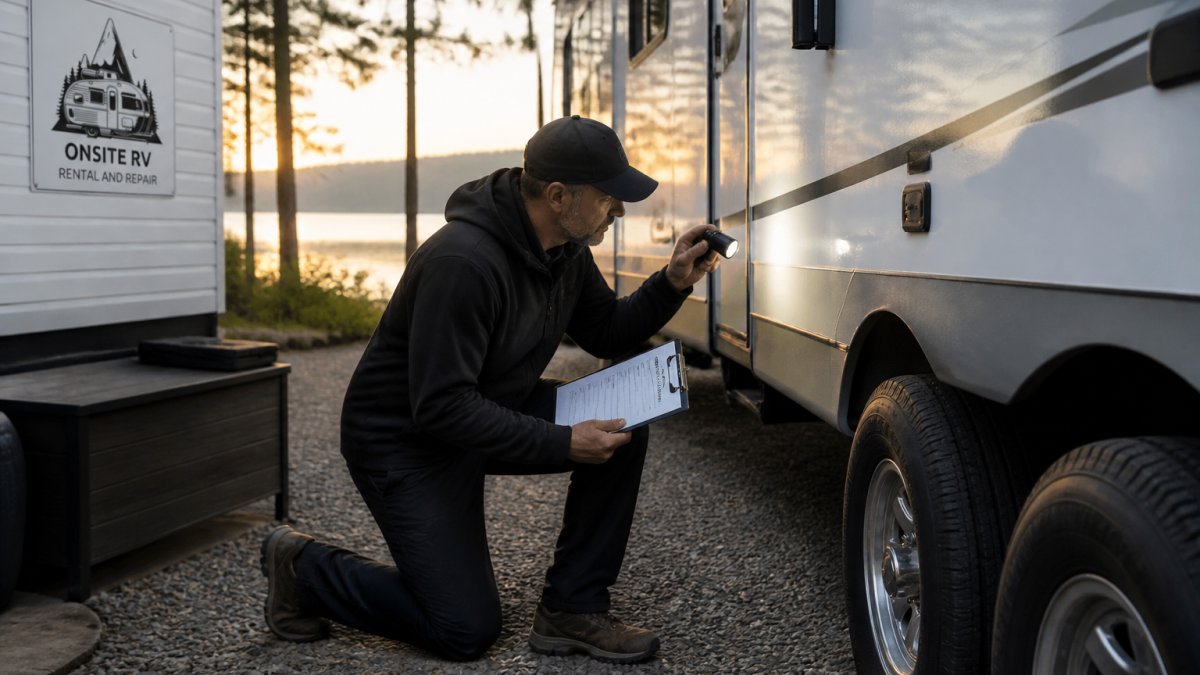
Before hitting the road, conduct a thorough walk-around inspection. It takes 30 to 45 minutes and catches issues before they strand you far from help.
Walk-Around Inspection Checklist
Start outside and work your way around the RV. Check tire pressure and condition on all wheels for cracks, bulges, or uneven wear. Examine seals and seams around windows, doors, and roof penetrations, your first line of defense against water intrusion, for cracks, gaps, or deterioration.
Interior System Checks
Inside, test all appliances: stove, oven, refrigerator, air conditioner, furnace, and water heater. Run water at all sinks and check for leaks under cabinets. Look for water stains on ceilings and walls, which indicate leaks. Check cabinet hinges, door latches, and storage compartments for damage.
RV Maintenance Checklist: Routine Tasks by Interval
A maintenance interval only works if you can act on it. The table below consolidates routine tasks into a single calendar you can print, tape inside a cabinet door, and check off. Intervals are starting points; your owner's manual and actual use pattern override them. A full-timer running the water pump daily needs plumbing inspections more often than a weekend owner.
| Interval | Task | Motorized | Towable | Safety stop-point |
|---|---|---|---|---|
| Before every trip | Tire pressure and visual condition (all wheels, including spare) | Yes | Yes | Sidewall bulge, cord showing, or pressure more than 10 PSI below spec: do not tow or drive |
| Before every trip | Lights: brake, turn, running, backup | Yes | Yes | Any non-working brake or turn light: fix before moving |
| Before every trip | Hitch, coupler, safety chains, breakaway cable (towable) | n/a | Yes | Cracked coupler, worn latch, or frayed chain: do not tow |
| Before every trip | Propane leak sniff at tank and regulator (soapy water) | Yes | Yes | Bubbles or propane odor: shut valve, ventilate, do not light appliances |
| Monthly | Battery voltage and terminal condition | Yes | Yes | Below 12.4 V rested after charging, or swollen case: replace before relying on it |
| Monthly | Propane and CO detector test | Yes | Yes | Alarm fails to sound: replace detector before next trip |
| Monthly | AC filter clean or replace (cooling season) | Yes | Yes | n/a |
| Monthly | Under-sink and appliance leak visual | Yes | Yes | Active drip: shut off pump or city water, repair before use |
| Quarterly | Roof and sealant visual (vents, skylights, seams) | Yes | Yes | Soft spot, active water stain, or separated sealant: reseal before rain |
| Quarterly | Undercarriage visual: loose wires, hanging components | Yes | Yes | Anything hanging or rubbing: secure before moving |
| Semi-annual | Brake pad thickness and brake fluid level (motorized) | Yes | n/a | Pads at or below 2.4 mm: service before towing |
| Semi-annual | Wheel bearing and brake adjustment (towable) | n/a | Yes | Grinding, heat, or grease leak: service before towing |
| Annual | Water system sanitize | Yes | Yes | n/a |
| Annual | Propane system professional inspection | Yes | Yes | Any leak found: technician only |
| Annual | Roof reseal of penetrations | Yes | Yes | n/a |
| Annual | Engine oil and filter (motorized) | Yes | n/a | n/a |
| Annual or per manual | Transmission service (motorized) | Yes | n/a | n/a |
| Annual | AC professional service and refrigerant check | Yes | Yes | n/a |
| Annual | Battery load test and age review | Yes | Yes | Over 3-5 years old and failing load test: replace |
How to Track It Without an App
A clipboard in the RV works. For each task, record the date, odometer or hour meter reading, who did the work, and any issue found, and keep receipts in the same folder. When you sell, this log is the difference between a buyer trusting your maintenance claims and walking away.
Adjusting Intervals for How You Camp
- Boondocking or dry camping: Check battery voltage every two to three days, not monthly, and inspect the water pump area weekly for drips.
- Full-time living: Treat monthly tasks as biweekly, and inspect roof seals every two months rather than quarterly.
- Storage months: The pre-trip list still applies before the first trip out, plus a full recommissioning (see the seasonal section).
Engine and Chassis Maintenance for Motorized RVs
Motorized RVs require engine and chassis care beyond what towables need. Regular maintenance keeps your engine running reliably for years.
Oil and Fluid Changes
Change your oil and filter per your manufacturer's schedule, typically every 5,000 to 10,000 kilometers or every six months, whichever comes first, using the grade specified in your owner's manual. Inspect fuel lines regularly for cracks or leaks. For extended storage, add fuel stabilizer and run the engine briefly every few weeks to circulate oil and prevent internal corrosion.
Tire and Brake Inspection
Inspect tires monthly for pressure, wear, and damage. Underinflation causes uneven wear and hurts fuel economy; overinflation wears the center and handles poorly. Check brakes monthly for unusual noises or a soft, spongy pedal. Have pads inspected annually and replaced at 2.4 millimeters thickness.
RV Battery Maintenance: Keeping Power Systems Healthy
Your RV battery powers essential systems when you're not on shore power. A dead battery leaves you without water, lights, refrigeration, and heating, so regular maintenance prevents failures and extends battery life.
Wet-Cell and AGM Battery Care
Wet-cell batteries require monthly water level checks; use only distilled water, since tap water's minerals damage the battery. AGM (Absorbed Glass Mat) batteries are sealed and need no water, but still need terminal cleaning and tight connections. Inspect both types annually for cracks, leaks, or swelling, signs replacement is needed.
Charging, Storage, and Winter Preparation
Charge your battery fully before extended storage; a discharged battery can freeze in winter and suffer permanent damage. In winter, disconnect the battery if the RV is stored and store it somewhere warm if possible, since cold slows charging and reduces capacity.
RV Air Conditioner Maintenance: Cooling System Care
Your air conditioner is essential for summer comfort. Regular maintenance keeps it running efficiently and prevents costly repairs.
Cleaning AC Vents and Filters
Check and clean your AC filters monthly during the cooling season. Dirty filters reduce cooling efficiency and strain your system. Filters are typically located inside the RV near the air handler. Inspect your AC unit on the roof quarterly. Look for debris, leaves, or damage.
HVAC System Inspection and Refrigerant Checks
Have your air conditioner professionally inspected annually. A technician will check refrigerant levels, test pressures, and inspect the compressor and condenser. Test your air conditioner before the cooling season begins. Run it for 15 to 20 minutes and verify that it cools properly and doesn't make unusual noises.
RV Plumbing System Maintenance: Water and Waste Care
Your plumbing system delivers fresh water and removes waste. Proper maintenance prevents leaks, contamination, and system failures that leave you without water or create sanitation hazards.
Water System Sanitation and Pressure Regulator Checks
Sanitize your fresh water system annually, especially after winter storage. Drain your fresh water tank completely. Mix one-quarter cup of household bleach per 57 liters of water in your tank. Check your water pressure regulator monthly. A regulator prevents high water pressure from damaging your plumbing system and appliances.
Preventing Leaks and Winterizing Water Lines
Inspect under all sinks monthly for water stains or drips. Check the toilet for leaks by watching the gray water tank level; it shouldn't rise if the toilet isn't used. Before winter storage, winterize your water system to prevent freeze damage. Turn off your water heater and let it cool.
Propane System Inspection and Safety
Propane powers your furnace, water heater, stove, and other appliances. A propane leak is a serious safety hazard. Regular inspection catches problems before they become dangerous.
Tank Condition and Fitting Inspection
Inspect your propane tank monthly for leaks, rust, or damage. Check all fittings and connections at the tank, regulator, and appliances. Check your tank valve annually. It should open and close smoothly without leaking. Inspect the regulator for cracks, corrosion, or damage.
Leak Detection and Appliance Function
Test your propane detector monthly. Most detectors have a test button; press it and verify the alarm sounds. Test each propane appliance monthly. Unusual sounds, smells, or failure to ignite indicate a problem requiring professional service. Have your entire propane system professionally inspected annually.
Exterior and Roof Maintenance: Seals, Seams, and Cleaning
Your roof and exterior protect everything inside from weather. Neglecting these systems leads to water damage, mold, and structural problems that are expensive to repair.
Roof Inspection and Seal Maintenance
Inspect your roof quarterly, more frequently in areas with heavy rain or snow. Reseal your roof and all penetrations annually or when you notice gaps or cracks. Clean your roof annually to remove debris, leaves, and dirt that hold moisture and accelerate deterioration.
Undercarriage and Exterior Cleaning
Inspect your undercarriage quarterly for loose components, hanging wires, or damage. Look for rust, corrosion, or signs of water intrusion. Clean your exterior regularly to prevent dirt and salt buildup that corrodes metal and damages paint. Inspect your windows and doors for cracks, gaps, or deterioration.
| Maintenance Task | Interval | Priority | Difficulty |
|---|---|---|---|
| Battery water level check | Monthly | High | Easy |
| Tire pressure and condition | Monthly | High | Easy |
| Propane detector test | Monthly | Critical | Easy |
| AC filter cleaning | Monthly | Medium | Easy |
| Roof inspection | Quarterly | High | Medium |
| Brake inspection | Annually | Critical | Hard |
| Battery service | Annually | High | Hard |
| Water system sanitization | Annually | High | Medium |
| Propane system inspection | Annually | Critical | Hard |
| Engine oil change (motorized) | 5,000-10,000 km | High | Medium |
Seasonal Maintenance: Spring, Summer, Fall, and Winter
Your RV's needs change with the seasons. A seasonal maintenance calendar keeps your systems healthy year-round.
Spring Recommissioning After Winter Storage
After winter storage, your RV needs a thorough recommissioning before use. Check your battery voltage and charge fully if needed. Flush your fresh water system thoroughly to remove antifreeze from winter storage. Inspect your roof, seals, and exterior for damage from winter weather.
Summer Travel Readiness and Mid-Season Checks
Before summer travel, verify that all systems are functioning properly. Test your air conditioner under load to ensure it cools adequately. During summer travel, monitor your systems more closely. Check your battery voltage weekly if you're boondocking without shore power.
Fall Preparation and Winterization
As temperatures drop, prepare your RV for winter or storage. Have your furnace serviced and tested. Verify that your propane system is working and leak-free. Winterize your water system as described in the plumbing section. Drain your tanks completely and add antifreeze to all lines.
DIY Maintenance vs. Professional Service: When to Call a Technician
Many maintenance tasks are simple enough for owners to handle. Others require specialized tools, training, or diagnostic equipment. Knowing the difference saves money and prevents damage.
Tasks You Can Handle Yourself
Check tire pressure and condition; you only need a tire gauge and visual inspection. Winterize your water system, requires antifreeze, basic plumbing knowledge, and compressed air or a hand pump. Wax your exterior and clean your roof, requires appropriate cleaning products and a soft brush.
When Professional Diagnostics and Repair Are Necessary
Engine service requires specialized tools and knowledge; have a qualified mechanic handle oil changes, transmission service, and engine diagnostics. Propane system repairs are safety-critical. Never attempt to repair a propane leak or appliance problem yourself. Air conditioner service requires refrigerant handling and specialized tools. Simple leaks you might handle, but complex plumbing problems warrant professional service.
Troubleshooting Common RV System Problems
Troubleshooting is not the same as repairing. The goal of the checks below is to confirm the symptom, rule out the simple causes, and decide whether to keep going or hand it to a technician. Every section ends with a stop-point: the moment you should stop diagnosing and book service.
Electrical: Dim Lights, No Power, Slow Battery Drain
First checks (owner-safe):
- Read battery voltage at rest with a multimeter. 12.6 V or higher is healthy; 12.4 V or lower means charge it before drawing conclusions.
- Confirm the battery disconnect switch is on and the terminals are clean and tight.
- If on shore power, confirm the pedestal breaker is on and the cord is fully seated.
- If lights dim only when the furnace or pump kicks on, note it; that points to battery capacity or a weak connection, not a failed light.
Warning signs that mean stop: burning smell, hot cable ends, scorched terminals, or a battery case that is swollen or leaking. Disconnect and do not use the system.
Hand to a technician when: voltage collapses quickly under light load (possible parasitic drain or failing battery), the converter or charger does not raise voltage when on shore power, or any 120 V circuit trips repeatedly.
Water: Leaks, Low Pressure, Odd Taste or Smell
First checks (owner-safe):
- Dry every fitting under sinks and around the water heater, then run the pump and watch for fresh drips.
- If pressure is low on city water, check the pressure regulator and the inlet screen; a clogged screen is common.
- If pressure is low on the pump, confirm the fresh tank has water and the pump strainer is clean.
- If water smells or tastes off, sanitize the system and replace the drinking-water hose before assuming a tank problem.
Warning signs that mean stop: water pooling near the water heater, a soft floor near the bathroom or kitchen, or a ceiling stain that grows after rain. Those point to concealed leaks that damage structure.
Hand to a technician when: the leak is behind a wall or under the floor, the water heater is leaking from the tank itself, or the black tank drains slowly despite a full tank (possible blocked vent or valve).
Cooling: AC Runs But Does Not Cool
First checks (owner-safe):
- Confirm the thermostat is set to cool and the fan is on auto or high.
- Clean or replace the filter and check that return-air grilles are not blocked.
- From outside, confirm the unit is not buried in debris and the condenser fins are not packed with dirt or cottonwood.
- Feel the air at the vents; if it is cool but weak, airflow is the issue, not refrigerant.
Warning signs that mean stop: ice forming on the indoor coil or refrigerant lines, or a burning smell from the unit.
Hand to a technician when: airflow is good but the air is not cold, the unit short-cycles, or you hear compressor noise.
Heating: Furnace Will Not Light or Heats Poorly
First checks (owner-safe):
- Confirm propane is on at the tank and other propane appliances light.
- Check the thermostat and the furnace breaker or fuse.
- Confirm the return-air grille is not blocked and the outside vent is clear of debris, nests, or mud dauber plugs.
Warning signs that mean stop: propane odor, soot at the exhaust, or repeated lockouts after resetting. Shut the propane off and ventilate.
Hand to a technician when: the blower runs but there is no ignition after two reset attempts, or the flame looks lazy or yellow.
Refrigerator: Warm Box on Propane or Electric
First checks (owner-safe):
- Confirm the RV is level; absorption refrigerators need leveling to circulate.
- Confirm the selected mode (propane or electric) matches the available supply.
- Check that the exterior vent is clear and the interior is not overpacked, which blocks airflow.
Hand to a technician when: it works on one mode but not the other, or the cooling unit shows yellow residue at the back. Yellow residue is a sign of a failed cooling unit and is not a DIY repair.
Propane: Smell, Alarm, or Appliance Will Not Stay Lit
First checks (owner-safe):
- If you smell propane, shut the tank valve, extinguish flames, open windows and doors, and leave the RV. Do not operate switches.
- If no smell but an appliance will not stay lit, confirm the tank has fuel and the valve is fully open.
- Soapy-water test the accessible fittings at the tank and regulator; bubbles mean a leak.
Warning signs that mean stop: any confirmed leak, a detector alarm, or a regulator that is cracked or corroded.
Hand to a technician when: a leak is confirmed, the regulator is suspect, or an appliance lights but goes out.
Creating Your Personal RV Maintenance Calendar
A written maintenance calendar keeps you organized and ensures nothing gets overlooked. Track what you've done and plan upcoming service.
Tracking Maintenance History and Intervals
Create a simple spreadsheet or use a dedicated RV maintenance app. Record the date, mileage (for motorized RVs), task performed, and any issues found. Set reminders for upcoming maintenance based on your calendar. If your oil change interval is 5,000 kilometers, set a reminder when you reach 4,500 kilometers.
Setting Reminders and Planning Service Appointments
Use your phone's calendar or a dedicated app to track maintenance intervals. Set recurring reminders for monthly checks, battery, tires, propane detector, AC filters. Plan service appointments with ONSITE RV RENTAL AND REPAIR well in advance, especially during busy seasons. Our team travels to you for mobile service or works in our Port Alberni shop.
Maintaining your RV systems requires commitment, but the payoff is reliability and safety for every adventure.
Frequently Asked Questions
How often should RV systems be inspected?
RV systems should be inspected before every trip, then monthly during active use, quarterly for deeper checks, and annually for comprehensive maintenance. Seasonal changes require additional inspections: spring after winter storage and fall before winterization. The frequency depends on how often you use your RV and the age of your systems. Older RVs may need more frequent checks. Many owners create a maintenance calendar to stay on track with these intervals.
What should be included in a seasonal RV maintenance checklist?
A seasonal checklist should cover propane tank inspection, battery condition assessment, water system sanitation, roof and seal inspection for leaks, tire pressure and condition, brake function, engine fluids, AC system filters, and exterior cleaning. Spring recommissioning includes flushing water lines and testing all appliances. Fall winterization involves draining water systems, protecting batteries, and inspecting seals. Summer checks focus on cooling system performance and tire wear. Adjust your checklist based on your climate and RV type.
How do you maintain an RV battery?
Maintain your RV battery by checking water levels monthly if it's a wet-cell type, keeping terminals clean and corrosion-free, and ensuring proper charging. Monitor voltage regularly using a multimeter. During storage, disconnect the negative terminal and use a trickle charger to maintain charge. In winter, protect batteries from extreme cold by insulating or storing them indoors. AGM batteries require less maintenance but still need regular charging and inspection. Replace batteries every 3-5 years depending on use and climate conditions.
Can I use Dawn dish soap to wash my RV roof?
Avoid using Dawn or other household dish soaps on your RV roof. These products can strip protective coatings and damage rubber seals and seams. Instead, use RV-specific roof cleaners or mild solutions designed for travel trailers and motorized RVs. Always rinse thoroughly with fresh water and inspect seals afterward. When cleaning, be careful not to pressure wash, as high pressure can force water into seams and cause leaks. If you're unsure about cleaning products, consult your RV manufacturer's guidelines or ask a professional technician.
What is the most common RV repair?
Water leaks are among the most common RV repairs, often caused by deteriorating seals and seams around windows, doors, and roof vents. Electrical system failures, battery problems, and plumbing issues are also frequent. Regular inspection of seals and seams, prompt caulking repairs, and preventive maintenance can reduce the risk of costly water damage. Catching leaks early is critical because water intrusion can damage insulation, cabinetry, and structural components. Professional diagnostics help identify hidden leaks before they become major problems.
How do you maintain an RV air conditioner?
Maintain your RV air conditioner by cleaning or replacing filters monthly, clearing AC vents of dust and debris, and ensuring the condenser coils stay clean. Check refrigerant levels annually and have a professional inspect the system if cooling performance drops. Before storage, run the AC for 15 minutes monthly to circulate fluids and prevent seal degradation. In spring, test the system before your first trip. Keep vegetation and debris away from exterior AC units. Professional servicing every 1-2 years helps catch problems early.
How do you maintain an RV water system?
Maintain your RV water system by sanitizing it annually using approved sanitizers, flushing lines regularly, and checking the pressure regulator for proper function. Inspect hoses for cracks or leaks monthly and replace them every 5-7 years. Keep the fresh water tank clean and use a water filter for better quality. In winter, drain all water lines and add RV antifreeze to prevent freezing and burst pipes. Test your water heater and check for leaks around connections. Have a professional inspect the system if you notice low pressure, discolored water, or unusual odors.
How should you maintain an RV refrigerator and other appliances?
Maintain your RV refrigerator by keeping it level, cleaning coils and vents monthly, and checking the seal around the door. Test both propane and electric modes regularly. For other appliances, clean filters in your furnace and water heater, inspect stovetop burners, and run your microwave vent fan regularly. Check all appliance connections and hoses for wear. Before storage, run each appliance briefly to keep seals from drying out. Have a professional inspect propane appliances annually for safety and efficiency. Replace worn seals and gaskets promptly to prevent leaks and inefficiency.